
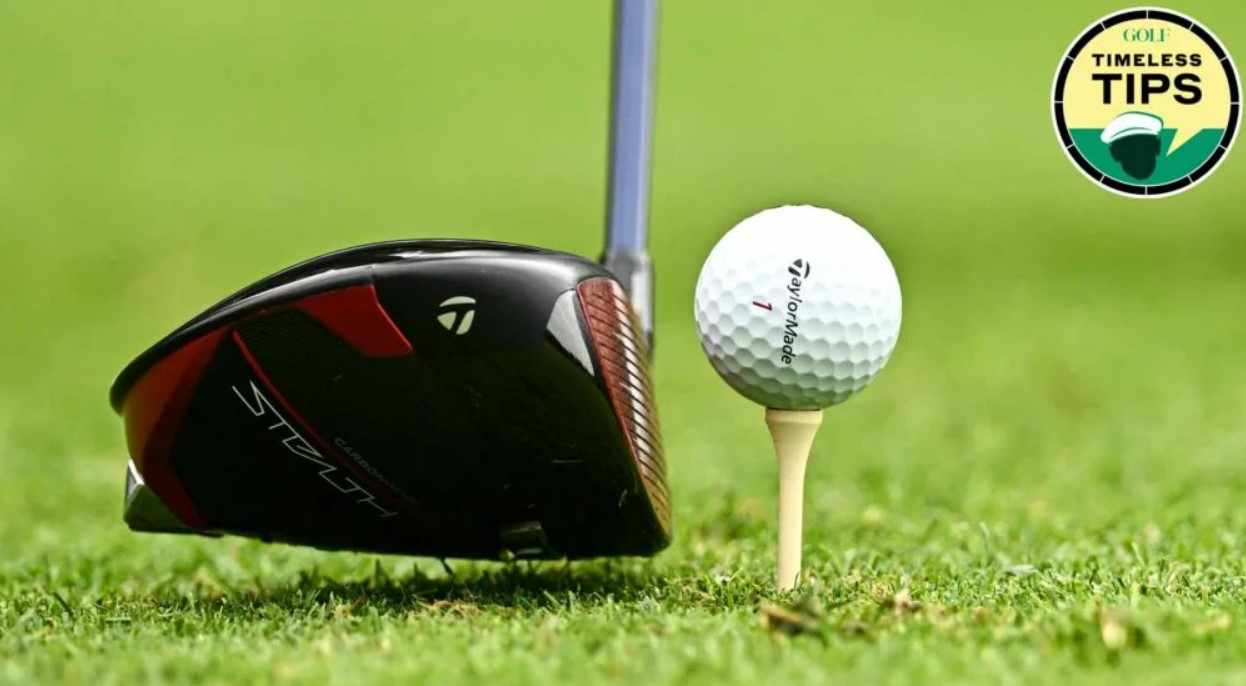
Golf instruction is ever-evolving, but the best advice stands the test of time. In our new series, Timeless Tips, we’re highlighting some of the greatest advice teachers and players have dispensed in the pages of GOLF Magazine. This week, we look back at an experiment conducted by GOLF Magazine back in 2006 that reveals the correct tee height for your driver.
Everyone likes to let it rip off the tee, but lots of recreational players struggle to find consistency with the big stick. There’s nothing more frustrating than watching your playing partners drive it past you, yet it’s something that weekend warriors know all too well.
Some of these struggles come from simple swing flaws that can be tough to correct and often need professional guidance to sort out. However, sometimes golfers are giving up distance because of setup errors.
For example, most players have no idea how high they should truly be teeing the ball up when they step to the tee box. Luckily for you, dear readers, GOLF Magazine conducted an experiment back in the mid-2000s to find an answer. Check out the results below straight from our June 2006 issue.
Who took part
Twenty-seven golfers, aged 25 to 71, with handicaps ranging from scratch to 29. Of the players, 25 typically used a mid-tee height and two preferred a high tee height.
The tee heights
- Low: The top edge of the ball was even with the top edge of the driver, so the entire ball was below the crown.
- Mid: Half the ball above the crown.
- High: The bottom edge of the ball was slightly above the top edge of the clubface so that the entire ball was above the crown.
Players were divided into three groups of nine by handicap level: 0-9, 10-19 and 20+. Each golfer hit 10 drives at each tee height, with each group hitting from the three tee heights in varying order to ensure that fatigue and motivation were balanced within each group. Only the best five out of the 10 drives at each tee height were recorded so that mis-hits would not skew the data.
Carry distance was measured by a launch monitor, which also calculated clubhead speed, launch angle, ball speed, and spin. Accuracy was also recorded: drives that landed in the fairway (33 yards wide) scored 1; those in the right or left rough (17 yards wide) scored 2; and those that landed beyond the rough scored 3.
Within each of the three handicap levels, carry distance for mid and high tee heights was significantly longer than the low tee height, largely an effect of the higher tees promoting higher launch angles and less spin. The high tee height provided the most distance, giving the players an average of 12 yards more carry per drive than the low tee height.
Low handicap (0-9)
| Carry distance (yards) | Launch angle (degrees) | Spin (rpm) | Clubhead speed (mph) | Ball speed (mph) |
|---|---|---|---|---|
| 211.64 | 10.5 | 4,051 | 98.32 | 138.59 |
Mid handicap (10-19)
| Carry distance (yards) | Launch angle (degrees) | Spin (rpm) | Clubhead speed (mph) | Ball speed (mph) |
|---|---|---|---|---|
| 171.46 | 12.4 | 3,844 | 86.04 | 120.9 |
High handicap (20+)
| Carry distance (yards) | Launch angle (degrees) | Spin (rpm) | Clubhead speed (mph) | Ball speed (mph) |
|---|---|---|---|---|
| 160.85 | 11.23 | 3,834 | 85.39 | 120.15 |
High-handicappers benefited the most from the high tee height, picking up an average of 18 yards over their drives with the low tee height.
The increases in carry distance from the low to the mid and high tee heights did not come at the expense of accuracy in terms of hitting the fairway. The table below presents the percentage of tee shots landing in the fairway, rough, and beyond the rough as a function of tee height.
| Fairway | Rough | Beyond rough |
|---|---|---|
| 58.5% | 30.4% | 11.1% |
Following the experiment, nine out of 27 players planned to change from mid to high tee height. Three of those nine were from the low-handicap group.
The tee height study was conducted by GOLF Top 100 Teacher Eric Alpenfels and Bob Christian, Ph.D dean emeritus of the School of Health and Human Performance at the University of North Carolina-Greensboro.
Frequently Asked Questions
Q: What was the purpose of this experiment?
A: The experiment aimed to determine the correct tee height for driving the ball.
Q: How were the players divided for the experiment?
A: The players were divided into three groups based on their handicap level: 0-9, 10-19, and 20+.
Q: What were the different tee heights used in the experiment?
A: The tee heights used were low, mid, and high, with each one having a different placement of the ball in relation to the driver.
Q: Did the tee height affect the distance of the drives?
A: Yes, the tee height had a significant impact on the carry distance of the drives, with higher tee heights resulting in longer distances.
Leave a Reply