
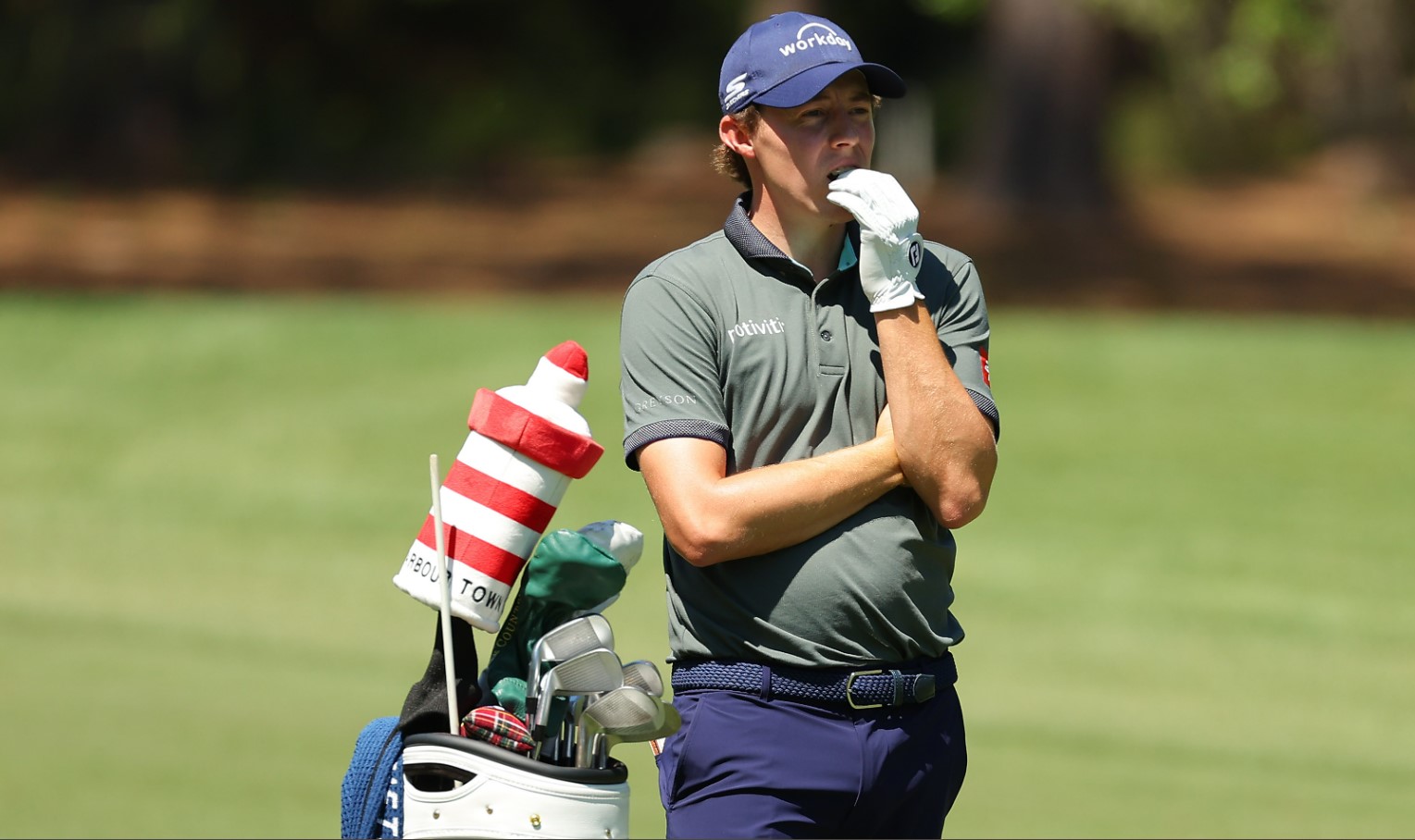
When it comes to professional golf, even the slightest equipment fitting gaffe can have a significant impact on a player’s performance. Just ask Matt Fitzpatrick, the 2022 U.S. Open champion, who recently discovered that he had inadvertently been playing with four extra grams of weight in his Titleist TSi3 driver for over a year. This unexpected revelation led to an over-rotation of his clubhead, resulting in wayward tee shots and a general sense of confusion in his swing.
Fortunately, Fitzpatrick was able to rectify the situation by removing the excess weight from his driver. However, the improvement in his driving did not immediately translate into better finishes in tournaments. Despite a promising T15 at the Phoenix Open, Fitzpatrick experienced a slight dip in form with MC-T21-MC in his following three starts. Nevertheless, he showcased a resurgence in his game by finishing 5th at the Players Championship and securing a top 10 finish at the Texas Open.
Now, as Fitzpatrick takes on Augusta National for the 88th Masters, he faces a new challenge – his struggles with short irons. The Augusta National Golf Club is known for its rigorous course and demanding conditions, especially when the wind picks up. Precision and distance control are imperative for success on this course, and Fitzpatrick’s short irons, unfortunately, seem to be hindering his ability to excel.
The Perilous 18th Hole
During his first round at the Masters, Fitzpatrick found himself facing the notorious 18th hole. Arriving at the tee with a solid two under par, he had the opportunity to finish the round strongly. After a fantastic drive that hugged the left side of the fairway, Fitzpatrick was left with a seemingly straightforward short iron shot into the green of this uphill par-4 hole.
However, what appeared to be a routine shot turned into a moment of frustration for Fitzpatrick. His approach shot overshot the target by a significant margin, sailing over the green and into the crowd of spectators. Puzzled by his club’s inability to generate the necessary spin, Fitzpatrick could only question his short irons’ reliability. This unfortunate misstep resulted in a bogey, ultimately leaving him six strokes behind the leader, Bryson DeChambeau.
The Lingering Iron Dilemma
Fitzpatrick’s concerns about his short-iron control extend beyond a single hole mishap. Playing with Ping Blueprint S irons and a Titleist Pro V1x ball, Fitzpatrick has the freedom to choose any clubs he wants, as he does not have an exclusive contract with a particular manufacturer. However, this freedom comes with its own set of challenges.
Over the past two to three weeks, Fitzpatrick has increasingly struggled with his short-iron control. While the overall numbers associated with his iron play still appear acceptable, there are consistent instances during each round that leave him bewildered. “That is not right” has become a familiar statement for Fitzpatrick, as a select few short irons refuse to behave as expected, resulting in costly mistakes.
When faced with such a precise and demanding course like Augusta National, Fitzpatrick’s iron dilemma becomes all the more concerning. To make matters worse, he admits that there is little he can do within the constraints of his current club set. Despite hitting 11 out of 14 fairways and demonstrating an ability to navigate Amen Corner with birdies on holes 11, 12, and 13, he found himself struggling on the final stretch of the course, dropping shots on holes 14, 17, and 18.
Nonetheless, Fitzpatrick remains hopeful. While he may be deflated with his overall score of one under par, he recognizes that the first round is just the beginning of a long tournament. Additionally, he acknowledges that the challenging conditions brought about by the wind were somewhat mitigated by the previous night’s rain, which softened the greens.
Looking ahead, Fitzpatrick knows that there are many more opportunities to improve and make up lost ground. As he seeks to overcome the hurdle of his short-iron struggles, he remains determined and committed to find a solution, even if the precise answer eludes him for now. The Masters is undoubtedly a test of skill, adaptability, and mental fortitude, and Fitzpatrick is fully aware of the uphill battle that lies ahead.
Frequently Asked Questions (FAQs):
How has Matt Fitzpatrick’s equipment hindrance affected his performance?
Playing with extra weight in his driver resulted in over-rotation and pulled tee shots, causing confusion in his swing. Additionally, his short irons have been lacking the necessary spin, leading to inconsistency and frustration.
What clubs does Matt Fitzpatrick play with?
Matt Fitzpatrick plays with Ping Blueprint S irons and uses the Titleist Pro V1x ball. He does not have an exclusive contract with any club manufacturer.
Is Matt Fitzpatrick concerned about his iron dilemma?
While Fitzpatrick acknowledges the challenge posed by his short-iron struggles, he remains hopeful and determined to find a solution. He understands that the troublesome shots are short-lived and realizes that the course provides opportunities for recovery.
How did Matt Fitzpatrick perform in his first round at the Masters?
Matt Fitzpatrick finished his first round with a score of one under par. Despite encountering challenges with the wind, he felt deflated but optimistic about his performance with ample rounds still to play.
Leave a Reply